Inferno by Steven Hatch M.D
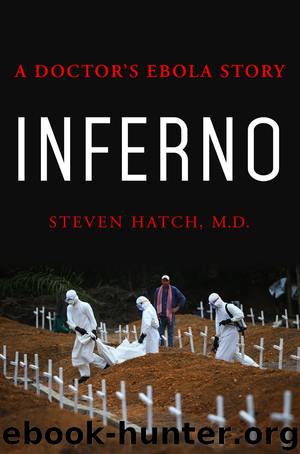
Author:Steven Hatch, M.D.
Language: eng
Format: epub
Publisher: St. Martin's Press
6
BEHOLD, A PALE HORSE
Blessed is he that readeth, and they that hear the words of this prophecy, and keep those things which are written therein: for the time is at hand.
—Revelation 1:3
The governments of Liberia, Sierra Leone, and Guinea did what they could to halt Ebola’s spread. Instituting a cordon sanitaire, as the West Point episode had demonstrated, was a dangerous and logistically nightmarish method of containment. The president of Sierra Leone, Ernest Bai Koroma, instituted a much larger cordon, restricting the movements of one million of his fellow citizens. International advisors howled in indignation, although not everyone in the West shared this opinion. Laurie Garrett, who had written the enormously influential The Coming Plague, wrote an opinion piece pointing out that in the Kikwit outbreak of 1995, the Zairean president Mobutu Sese Seko cordoned off the entire city, and the first truly large Ebola outbreak never spread to the rest of the country, or any other. But the Kikwit cordon may not have been the best model for President Koroma, for the Zairean military was much more organized, and there was only one road in and out of Kikwit, making it easily contained, while Koroma was attempting to seal off whole portions of his country. The debate wasn’t really about whether a cordon would be heartless or not. The debate was about whether it would be effective, or whether it might even take a critical situation and make it worse.
At the same time, another solution was being scaled up. Instead of placing a cordon around an entire community, local communities could simply construct a miniature cordon and place those requiring quarantine inside the facility. In Liberia, they came to be called Community Care Centers, but everyone at the ETU referred to them as holding centers. All that was needed was active community surveillance. If someone had come down with symptoms that required ETU evaluation and was eventually shown to be positive, the people living with that person could be brought to the holding center where they could wait their twenty-one days. If they themselves became ill, they could simply be transferred directly to the ETU. The logistical issues were less complicated by an order of magnitude. You didn’t have to think about food and drink for the whole community, but just those members at the highest risk. In theory, it seemed a sensible way to at the very least cut down on Ebola’s transmission.
In practice, however, holding centers were tricky places. They were often run by local groups who did not completely understand the nuances of risk stratification, so some people could find themselves placed in quarantine on the flimsiest of criteria and had little or no opportunity to appeal their detention once in. In the later months of the outbreak, unsettling rumors were circulating that some politicians held ever-greater numbers of people as proof of the success of their quarantine policies, even though the rate of infection was on a sharp decline throughout the country as 2014 came
Download
This site does not store any files on its server. We only index and link to content provided by other sites. Please contact the content providers to delete copyright contents if any and email us, we'll remove relevant links or contents immediately.
Waking Up in Heaven: A True Story of Brokenness, Heaven, and Life Again by McVea Crystal & Tresniowski Alex(37869)
Still Foolin’ ’Em by Billy Crystal(36404)
Cecilia; Or, Memoirs of an Heiress — Volume 1 by Fanny Burney(32635)
Cecilia; Or, Memoirs of an Heiress — Volume 2 by Fanny Burney(32010)
Cecilia; Or, Memoirs of an Heiress — Volume 3 by Fanny Burney(31996)
Fanny Burney by Claire Harman(26659)
Empire of the Sikhs by Patwant Singh(23135)
We're Going to Need More Wine by Gabrielle Union(19107)
Hans Sturm: A Soldier's Odyssey on the Eastern Front by Gordon Williamson(18648)
Plagued by Fire by Paul Hendrickson(17461)
Out of India by Michael Foss(16985)
All the Missing Girls by Megan Miranda(16307)
Cat's cradle by Kurt Vonnegut(15441)
Pimp by Iceberg Slim(14662)
For the Love of Europe by Rick Steves(14562)
Molly's Game by Molly Bloom(14193)
Bombshells: Glamour Girls of a Lifetime by Sullivan Steve(14135)
Leonardo da Vinci by Walter Isaacson(13407)
4 3 2 1: A Novel by Paul Auster(12505)
